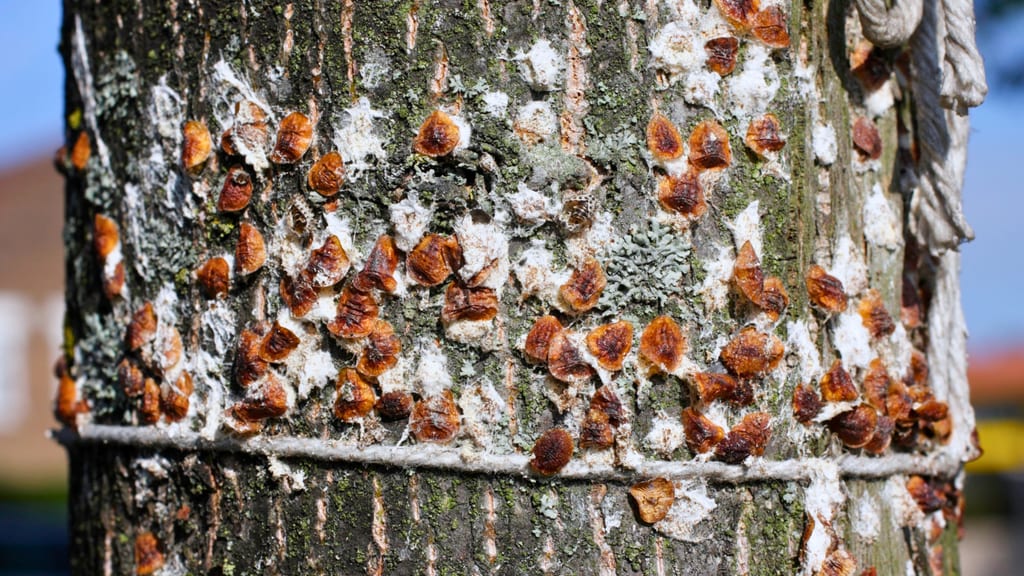
If you see white, popcorn-like tufts on your maple tree branches during the early summer in Michigan, you’re likely looking at cottony maple scale (Pulvinaria innumerabilis), a small insect that produces cottony egg sacs. Cottony maple scale is typically only an aesthetic issue, as it is usually kept in check by native predators.
However, predator populations occasionally fall, allowing cottony maple scale populations to explode, as each egg sac can contain as many as 1,000 eggs. We’ll explain how to identify cottony maple scale, outline the damage it causes, and provide tips that’ll help you determine when professional assistance is appropriate.
Cottony Maple Scale: Quick ID Check
If you notice any of the following, your trees are likely harboring cottony maple scale:
- White tufts on twigs in June
- Sticky leaves or surfaces below affected branches
- Flat brown bumps near the white tufts
How to Identify Cottony Maple Scale
Cottony maple scale females are flat, brown, wingless insects that are about 1/8 inch long. They’re relatively inconspicuous, except when they begin producing ½-inch white egg sacs in the spring or early summer. Males are short-lived, have a single pair of wings, and are much smaller.
Crawlers — the highly mobile and immature life stage of the species — are even smaller and often measure less than 0.5 millimeters in length.
Cottony Maple Scale Hosts: Which Trees Are Vulnerable?
Silver maples (Acer saccharinum) and honeylocusts (Gleditsia triacanthos) are the preferred hosts for cottony maple scale insects.
However, they will also feed on many other species, including sugar maples (Acer saccharum), red maples (Acer rubrum), boxelders (Acer negundo), basswoods (Tilia spp.), birches (Betula spp.), elms (Ulmus spp.), and hackberries (Celtis spp.).

The Yearly Life Cycle of the Cottony Maple Scale in Michigan
Like many other common tree pests, cottony maple scale produces a single generation each year. Each generation consists of several different life stages, which occur at different points in the year.
| Stage | What it looks like | When |
|---|---|---|
| Overwintering Female | Small brown bumps on twigs | Fall to spring |
| Egg Sac | White cottony tufts up to ½ inch | Late spring to June |
| Crawler | Tiny, flat, clear-to-pale insects | Late June to July |
| Settled Nymph | Nymphs feeding along leaf veins | Summer |
Cottony Maple Scale Damage: What Happens to Infested Trees?
Cottony maple scale infestations can cause varying levels of damage, depending on the tree’s underlying health and the scale of the infestation. Some of the most common ways these insects create problems include:
- Excreting honeydew that coats lower portions of the tree, as well as anything else beneath the canopy.
- Fostering the development of sooty mold, which grows on the honeydew they produce.
- Causing twig and branch dieback via their feeding activity.
In most cases, natural predators will help keep cottony maple scale populations low, which helps limit the damage they cause. But in extreme cases, they can stress trees enough to cause decline and eventual death.
Seeing White Cottony Tufts on Your Trees?
While cottony maple scale outbreaks don’t always necessitate professional pest control services, they shouldn’t be ignored either. It’s often wise to have an ISA Certified Arborist evaluate infested trees to help determine the best course of action.
The professionals at Longtree Tree Service would be happy to inspect your trees, characterize the extent of the infestation, and determine if any Plant Health Care services are appropriate. Contact us today to schedule your complimentary onsite estimate, so you can stop worrying about these common tree pests.
Do You Need to Treat Cottony Maple Scale?
In many cases, no — you don’t have to treat cottony maple scale.
It doesn’t usually cause serious harm, and lady bugs, predatory flies, wasps, and birds will help keep pest populations low. However, treatment may be warranted in some cases, such as for heavily infested trees and those that are already suffering from significant stress.
When treatment is needed, arborists will usually apply dormant oils before bud break or spray the tree with insecticides effective for crawlers during late June or July. Systemic options that are applied as trunk injections or soil drenches may also be used in some cases.
Cultural controls can also be helpful. You may, for example, want to prune out heavily infested twigs. Keeping a 2- to 4-inch-thick layer of organic mulch over the root system and watering trees during dry periods can also help support their health, enabling them to better tolerate infestations.

Frequently Asked Questions About Cottony Maple Scale in Michigan
It can certainly be startling to see a number of white, cottony masses on your maple trees, and it leaves many homeowners with questions. We’ll answer some of the most common ones our clients have, regarding identification, damage, and treatment.
What is the white cotton on my maple tree?
The white, cotton-like masses on your maple tree are likely egg sacs produced by female cottony maple scale insects.
These sacs, which typically appear in late spring and early summer, can contain as many as 1,000 eggs. They often cluster along twigs and branches, making heavily infested trees look as though they're covered in bits of cotton.
Will cottony maple scale kill my tree?
Cottony maple scale rarely kills established, healthy trees. However, heavy infestations can weaken trees by removing sap, potentially causing premature leaf drop and twig or branch dieback. Trees already stressed by drought, disease, or other problems are more vulnerable to serious damage.
When is the best time to treat cottony maple scale?
The best time to treat cottony maple scale is during the crawler stage, when newly hatched insects are moving across the tree. This typically occurs from late June through July, depending on local conditions. Dormant horticultural oil applications before bud break may also help control overwintering scales.
Which trees does cottony maple scale attack?
Silver maple is one of the most common hosts of cottony maple scale, but it also attacks other maple species, including red maple, sugar maple, and boxelder. Other susceptible trees include basswood, birch, and elm.
Is cottony maple scale the same as lecanium scale?
No, cottony maple scale and lecanium scale are different types of soft scale insects.
Both feed on tree sap and produce sticky honeydew, but cottony maple scale females produce distinctive white, cotton-like egg sacs. Lecanium scales generally appear as small, rounded, brown bumps along twigs and branches, without the conspicuous white egg masses.
Why are the leaves and branches beneath my maple tree sticky?
Cottony maple scale (and several other insect species) produces honeydew, a sugary liquid excreted as the insects feed on tree sap. Honeydew can coat leaves, branches, sidewalks, vehicles, and outdoor furniture beneath infested trees. It also encourages the growth of sooty mold, a dark fungus that grows on the sticky residue.
Can cottony maple scale go away without treatment?
Yes, cottony maple scale infestations can — and often do — resolve on their own. Their populations often fluctuate naturally, and beneficial insects such as lady beetles and parasitic wasps can help keep infestations under control.
Healthy, established trees can usually tolerate light infestations without treatment. However, persistent heavy infestations, significant branch dieback, or declining tree health may warrant professional assessment and targeted control measures.
Get Your Maples Checked by a Southfield Arborist
Cottony maple scale may usually be little more than a cosmetic issue, but that doesn’t mean it isn’t wise to have a Southfield arborist evaluate infested trees. This will let you confirm that the pest is actually cottony maple scale and give you the chance to discuss your tree’s prognosis with a professional.
Whether your maples need Plant Health Care treatment or simple monitoring and supportive care, the Longtree Tree Service team will be happy to provide the services or guidance you need. We’ve been helping homeowners across Southeast Michigan care for their trees since 2019, and we’d love to assist you too.

Contact us today to schedule a free consultation and give your maples the best chance at a full recovery and long life.
Sources & References
- Michigan State University Extension – “Cottony maple scale – Integrated Pest Management”
Michigan IPM notes on cottony maple scale identification and natural enemies.
https://www.canr.msu.edu/resources/cottony_maple_scale - University of Kentucky Entomology – “Cottony Maple Scale Identification & Management (EF427)”
Life cycle, hosts, symptoms and management of cottony maple scale.
https://entomology.mgcafe.uky.edu/ef427 - Iowa State University Extension – “Cottony Maple Scale”
Identification and egg sac size and capacity.
https://yardandgarden.extension.iastate.edu/encyclopedia/cottony-maple-scale - Montana State University Extension – “Cottony Maple Scale”
Damage, crawler timing, monitoring and management options.
https://www.montana.edu/extension/Full_HTML_Pubs/a-guide-to-pests-problems-and-identification-of-ornamental-shrubs-and-trees-in-montana/insects/cottony-maple-scale.html - Penn State Extension – “Cottony Maple Scale”
Extension overview of how to identify Pulvinaria innumerabilis, its life cycle on silver maple and other hosts, the damage it causes (including leaf drop and branch dieback), and the timing of oil and crawler-stage treatments.
https://extension.psu.edu/cottony-maple-scale - Agriculture and Agri-Food Canada – “Guide to the Key Arthropods of Vineyards of Eastern Canada”
Federal field guide that covers how to identify the insect and mite pests of grapevines in eastern Canada, and when they are active, including cottony maple scale (Pulvinaria innumerabilis).
https://publications.gc.ca/collections/collection_2019/aac-aafc/A59-72-2019-eng.pdf - Michigan State University Extension – “Lecanium scale and cottony maple scale on honeylocust, silver maple and other street trees”
Reports of localized soft scale outbreaks in Southeast Michigan.
https://www.canr.msu.edu/news/lecanium_scale_and_cottony_maple_scale_on_honeylocust_silver_maple_and_othe