Skip to content
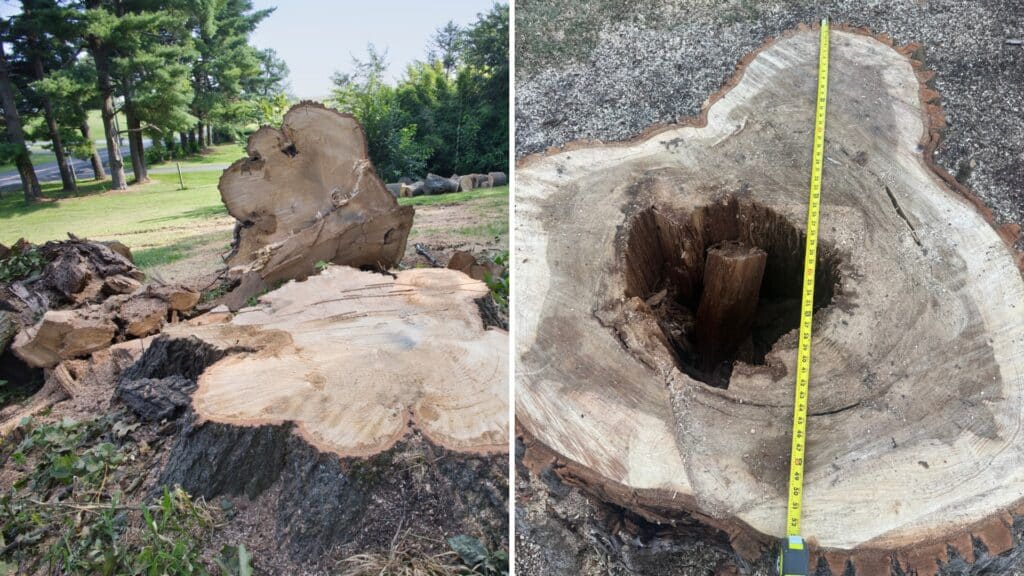
If you’ve ever had a tree removed from your property before, you know that the process typically leaves behind a sizeable tree stump. Most homeowners have these stumps removed in one way or another, but some decide to simply leave the stump in place.
That can be a big mistake, which may lead to a number of lingering problems. We’ll outline some of the reasons it is always a good idea to have tree stumps removed, as well as the one case that can be an exception.
Seven Reasons You Should Have Tree Stumps Removed
There are a number of reasons homeowners should have tree stumps removed, but the following are a few of the most important.
1. Trip Hazards
The number one reason to have tree stumps removed from your property boils down to simple safety: Stumps cause people to trip and fall all the time.
Aside from the fact that you certainly don’t want anyone walking on your property to become injured, it’s also important to note that you may be liable for the victim’s medical expenses in many cases. And these costs can be quite shocking.
The average hospital costs associated with an elderly person falling in the U.S. are approximately $30,000, according to the Centers for Disease Control and Prevention (CDC). Combine this with the fact that pain and suffering claims may be up to five times the actual medical expenses, and you can see how a simple tree stump could cost you $100,000 or more.
2. Pests
Rats, mice, and other rodents often take up residence in old tree stumps, particularly as the wood begins to decay.
And this doesn’t mean you’ll have a few rodents peacefully living outside your house — rodent populations tend to grow in explosive fashion, as a single female mouse can produce more than 50 offspring in a single year. At this point, you’ll likely need to hire a professional exterminator, which can cost up to $1,500 in some cases.
Rodents aren’t the only animals that take up residence in tree stumps, either. You may find that your yard becomes a haven for snakes, wasps, spiders, and other creepy crawlies, further illustrating the importance of having stumps removed promptly.
3. Resprouting
While surprising to many homeowners, some trees — up to 78% of individuals, according to one study — will produce a litany of fresh shoots after they’re cut down. Produced by latent buds living under the bark of the trunk or root system, these fresh shoots can grow quickly and eventually turn into full-fledged trees.
Even worse, these new sprouts are usually poorly attached, meaning that they’re at increased risk of failure. This may not be a huge problem while they’re still small, but if they’re allowed to persist for several years, they may grow large enough to present real safety risks.
Some trees are more likely to produce shoots than others, including:
- Oaks
- Maples
- Aspens
- Black locusts
- Willows
- Sweetgums
If you are having any of these species removed, it’s especially important to have the entire stump removed.
4. Disease Spread
While tree stumps may seem like benign components of the landscape, they can actually threaten the other trees in the area.
Say, for example, that you had a tree with oak wilt removed. The resulting stump will still harbor the fungus responsible for the disease, which may then spread to oaks up to 100 feet away via root grafts. Additionally, the cut stump may attract important vectors involved in the spread of the disease, such as sap-feeding beetles.
Even if the tree you had removed was largely healthy, the resulting stump will become colonized by fungus over time. Some of these fungi will release spores, which may then colonize nearby trees, leading to decay and a loss of structural integrity.
5. Mower Damage
Large tree stumps that stand several inches above ground level are often pretty easy to see and avoid when mowing your lawn.
However, trees are occasionally cut close to the ground, making it easy for the grass to obscure them. This could cause you to accidentally hit one with your mower, potentially resulting in repair costs that’ll exceed the value of the mower. Even if you have a high-end mower that is still worth repairing, you may be looking at up to $900 in repair costs.
But the actual stump isn’t the biggest danger to mowers — it’s the surface roots often left behind after a tree is removed. These roots are even harder to see than stumps, and they can quickly ruin even a professional-grade mower. This helps demonstrate why most stump grinding professionals also grind down surface roots in addition to the actual stump.
6. Property Obstruction
Aside from the risks tree stumps can present, it’s also worth pointing out that you can’t use the space surrounding a stump for any other purposes. It’s often difficult to grow grass in the area until the stump and surface roots are removed, and it’s often impossible to install a plant bed, hardscape, or new tree in the area.
This also illustrates one of the reasons it is generally wise to avoid using stump-removal techniques that rely on the use of salts or harmful chemicals.
These substances may very well accelerate the rate at which the stump decomposes, making it easier to remove the stump later, but they can also harm the soil in the area. This can make it difficult (if not impossible) to plant grass, shrubs, or trees in the area for quite some time.
7. Aesthetics
Simply put, tree stumps are eyesores. Even a single stump can make an otherwise-manicured lawn look neglected and shabby, never mind cases in which several stumps are present. This will not only prevent you from enjoying your property the way you deserve, but it can also influence things like curb appeal if you’re intending to sell your home in the near future.
For example, research from Virginia Tech found that upgrading a property from “poor” to “excellent” condition — which begins with removing tree stumps and other eyesores — can increase a home’s value by as much as 12.7%. For a $400,000 home, that can represent an additional $50,000.
Further, a 2023 survey by the National Association of Realtors found that professional landscape maintenance — including stump grinding services — has a typical ROI of 104%.

One Potential Exception: A Case in Which Removal Isn’t Always Necessary
We’ve used the word “always” a few times above, but we do need to clarify: While it is always a good idea to have tree stumps removed from urban and suburban properties, it may not always be necessary for those living on forested rural lots.
Stumps generally won’t harm the curb appeal of these kinds of properties, and the risks of someone tripping over a stump or damaging a lawn mower on one are also pretty low. Resprouting is also a pretty minor concern in these situations.
So, if you live on this kind of property, you can decide whether to remove stumps or not on a case-by-case basis.
Professional Stump Grinding from Longtree Tree Service
As you can see, tree stumps can cause a number of problems for homeowners (not to mention commercial property managers).
Fortunately, having them removed is quite easy — simply contact the professionals at Longtree Tree Service. Whether you’re located in Beverly Hills, Birmingham, Bloomfield Hills, or anywhere else in Southeast Michigan, we can provide the kind of stump-grinding services you need.
We’ll have a representative visit your property, provide you with an itemized estimate, and set up a stump-grinding appointment at a convenient time. Before you know it, your stumps will be gone, your property will be safer, and you’ll be able to use the space for your next landscaping project.
Sources & References
- Lawn Love – “How Much Does Lawn Mower Service Cost?”
This guide provides a breakdown of national average costs for professional mower maintenance, including tune-ups, blade sharpening, and engine repairs for various equipment types.
https://lawnlove.com/blog/lawn-mower-service-cost - Michigan State University Extension – “Understanding Oak Wilt”
This research-based publication identifies the biological characteristics of the Bretziella fagacearum fungus and outlines seasonal management strategies to prevent its spread within deciduous forests.
https://www.canr.msu.edu/news/understanding_oak_wilt - ResearchGate – “Influence of a Disturbance Gradient on Natural Regeneration and Understory Diversity in Semi-Deciduous Dense Forests of Cameroon”
This peer-reviewed study evaluates how varying levels of forest disturbance impact the biodiversity and regeneration capacity of tropical understory plant species.
https://www.researchgate.net/publication/398441992_Influence_of_a_disturbance_gradient_on_natural_regeneration_and_understory_diversity_in_semi-deciduous_dense_forests_of_Cameroon - National Association of REALTORS – “2023 Remodeling Impact Report: Outdoor Features”
This comprehensive report quantifies the return on investment and homeowner satisfaction levels for various residential landscaping and exterior improvement projects.
https://cms.nar.realtor/sites/default/files/documents/2023-03-remodeling-impact-outdoor-features-03-17-2023.pdf - Angi – “How Much Does a Rat Exterminator Cost?”
This resource analyzes the primary factors influencing pest control pricing, including infestation severity, treatment methods, and structural exclusion services.
https://www.angi.com/articles/how-much-does-rat-exterminator-cost.htm - Centers for Disease Control and Prevention – “Rodent Control After a Disaster”
This official federal guideline provides actionable strategies for managing rodent populations and mitigating disease risks following significant environmental disturbances or structural damage.
https://stacks.cdc.gov/view/cdc/83080